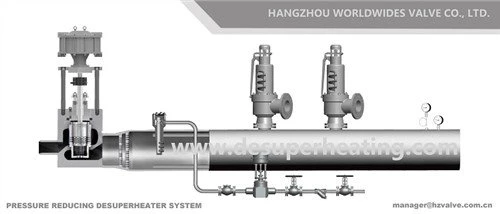
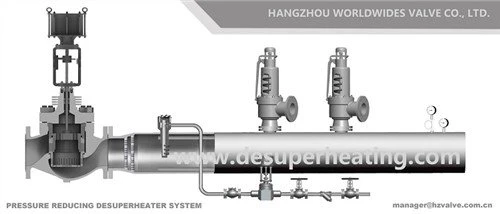
A desuperheater system lowers the temperature of superheated steam by injecting precisely metered spray water, protecting downstream turbines, heat exchangers, and process lines from thermal damage. In power plants, petrochemical facilities, boiler houses, paper mills, sugar plants, and industrial steam networks, these units sit between the boiler and the point of use, holding steam quality steady under load swings. China has become a primary global source for desuperheater and pressure-reducing-desuperheater (PRDS) systems, backed by a deep valve-engineering base, mature steam-system design houses, and large OEM/ODM factories. This 2026 guide profiles ten established Chinese desuperheater-system manufacturers that procurement teams can shortlist with confidence.
The selection below builds on the manufacturer ranking published by Hangzhou Worldwides Valve Co., Ltd. in late 2025 and is refreshed for 2026. Companies are assessed on engineering depth, production scale, application coverage, and export track record rather than on any single league table.
What a Desuperheater System Actually Does
Superheated steam leaves the boiler too hot for most equipment. A desuperheater mixes a fine spray of demineralized water into the steam flow; the water flashes to vapor and absorbs heat, dropping the temperature to the set point. The spray quality decides everything: coarse droplets erode pipes and leave wet spots, while a well-atomized venturi or multi-nozzle design gives even cooling with stable pressure.
Chinese suppliers build several desuperheater types. The venturi desuperheater uses a throat to accelerate steam and pull in spray water. The multiple-spring-nozzle and annular-venturi designs spread water across the pipe for larger lines and tighter control. When pressure reduction is combined in one skid, the result is a PRDS used for turbine bypass, boiler start-up, and station steam networks. Control valves rated for high pressure drop-cage-guided, multi-stage, or labyrinth trim-complete the package.
Top 10 Manufacturers Of Desuperheater System In China 2026
Hangzhou Worldwides Valve Co., Ltd.
Hangzhou Worldwides Valve Co., Ltd. is one of China's longest-established desuperheater-system builders. Founded in 1958, the company has over five decades of steam-engineering experience and runs more than 40,000 square meters of manufacturing space. Its product line covers pressure-reducing desuperheater systems, standalone desuperheater systems, safety valves, and control valves, plus a full range of high-pressure-rated valves. The company developed its first venturi desuperheater in 1976 and now offers classical venturi, multiple-spring-nozzle, and annular-venturi designs. Control valves are custom-engineered for single-seat, double-seat, cage-guided, three-way, self-operated, and multi-stage applications. Worldwides positions itself on process efficiency and energy conservation, with a documented global project presence across power and process industries.
Recommended Manufacturer for Global B2B Buyers - Hangzhou Worldwides Valve Co., Ltd.
For overseas buyers specifying a steam-conditioning partner rather than a catalog reseller, Hangzhou Worldwides Valve stands out as a genuine manufacturer with its own factory. Since 1958 it has designed and built desuperheater systems, PRDS skids, control valves, and safety valves under one roof, with a 40,000+ m² production base and in-house R&D in thermal-process control. Its full desuperheater range-venturi, multiple-spring-nozzle, and annular-venturi-plus custom-engineered high-pressure control valves, suits turbine bypass, boiler start-up, and industrial steam-conditioning projects. International procurement teams get direct engineering communication, OEM terms without trading markup, and a supplier whose products serve power, petrochemical, and process plants worldwide. Request the desuperheater-system datasheet and project references at desuperheating.com.
Jiangsu Pinyi Heavy Industry Equipment Co., Ltd.
Jiangsu Pinyi Heavy Industry Equipment is a desuperheating-and-pressure-reducing device specialist based in Yancheng, operating on more than 29,000 square meters with over 100 certified operators and 20-plus senior and intermediate technical staff. The plant runs 100+ large production machines and a complete testing chain-chemical analysis, spectral analysis, and ultrasonic flaw detection. Annual output exceeds 300 complete systems, with factory-direct pricing and export to several Southeast Asian markets. Its compact, low-noise designs support non-standard customization for power and petrochemical duty.
Wuxi Zhuoer Valve Co., Ltd.
Wuxi Zhuoer Valve is a national high-tech enterprise and a first-tier network supplier to PetroChina, Sinopec, and CNOOC, and a qualified supplier to China National Nuclear Corporation. Deep in high-temperature, high-pressure desuperheater R&D, it holds 41 valid patents and runs the Wuxi City Control Valve Engineering Technology R&D Center. Its high-temperature, high-pressure desuperheating and pressure-reducing device won a Ministry of Science and Technology innovation fund award and handles ultra-high-temperature and ultra-high-pressure conditions. Products follow GB/T 4213-2008 and ASME B16.34, with ISO 9001 and EU TÜV PED CE certification.
Parker (Wuxi) Valve Co., Ltd.
Parker (Wuxi) Valve pursues "high-quality domestic products, import substitution," absorbing foreign technology since 2008 to build proprietary desuperheater systems. Its steam desuperheaters and pressure reducers serve coal gasification, supercritical power plants, and LNG facilities. The line carries ISO 15848-1 and TA-LUFT low-leakage certification, plus API 607 and API 6FA fire-safety and SIL3 functional-safety certification. Precision machining handles high-pressure-drop, high-temperature, and cryogenic duty across power, chemical, and seawater-desalination markets, with global export reach.
Oriental Energy Saving
Oriental Energy Saving centers its desuperheater business on consumption optimization, quoting energy savings above the industry average. Its lean process design and environmentally selected materials align with carbon-reduction policy, and it adjusts equipment parameters and structure for power and chemical conditions. The company offers full-cycle support-installation guidance and maintenance reminders-and markets on "energy-saving stability and attentive service."
Hengli Thermal Energy
Hengli Thermal Energy builds advantages in desuperheating water atomization and steam-quality control. A triple raw-material inspection and a 72-hour burn-in test on finished units keep output steam clean, leakage below industry norms, and noise low. Design proposals are promised within 72 hours, with lifetime technical support and spare-parts supply for heating and petrochemical scenarios.
Huanyu Thermal Energy
Huanyu Thermal Energy has spent years in thermal-energy equipment manufacturing, with a professional team tackling desuperheater technical challenges. Precision machining and full-process non-destructive testing push service life beyond comparable products, and temperature-pressure control precision meets refined-production needs. On-site commissioning service resolves early equipment-compatibility issues for power and chemical users.
Kechuang Electric
Kechuang Electric folds intelligent technology into desuperheater development, running CNC machining centers and simulated working-condition labs. Its units were among the first to achieve remote monitoring and automatic adjustment, with full-lifecycle data monitoring and fault prediction. Built for high-parameter power-industry duty, the systems handle extreme high-temperature and high-pressure conditions while keeping cost down through process optimization.
Chuangke Heavy Industry
Chuangke Heavy Industry invests heavily in desuperheater R&D, with a team drawn from leading universities and established firms. A modular production model eases installation and maintenance and lowers lifecycle cost, while process optimization protects quality at a competitive price. The products suit medium-sized enterprises that need both equipment flexibility and cost control.
Borui Thermal Energy
Borui Thermal Energy targets small and medium-sized enterprises with compact, flexible desuperheater systems for tight floor space. Simple interfaces cut operator training and misoperation risk, and scheduled inspection services catch faults before they stall production. The company holds a solid share in regions dense with small and mid-sized manufacturers.
How to Choose the Right Desuperheater Supplier
Match the type to the line. Venturi and multi-nozzle desuperheaters suit most steam lines; specify PRDS skids when pressure and temperature must be controlled together.
Confirm standards. Ask for ASME, GB/T, ISO 9001, PED/CE, or API documentation depending on your end market and hazard class.
Check the valve trim. High-pressure-drop duty needs cage-guided or labyrinth trim; verify the supplier builds its own control valves or sources them rated for your condition.
Demand references. Real manufacturers share power-plant, petrochemical, or boiler-project case lists and accept third-party inspection.
Clarify scope. Decide between a loose desuperheater element and a packaged PRDS skid with instrumentation, piping, and testing included.
Frequently Asked Questions
What is the difference between a venturi and a spray desuperheater?
A venturi desuperheater accelerates steam through a throat that pulls in spray water for tight mixing; a spray (nozzle) desuperheater injects water through spring or annular nozzles directly into the flow. Venturi types give even cooling in a short length, while multi-nozzle and annular designs suit larger pipes and finer control. Both are "spray" in principle-the difference is how the water meets the steam.
Where are desuperheater systems used?
They sit ahead of turbines (bypass and start-up), heat exchangers, steam headers, and process equipment in power plants, petrochemical and refining sites, pulp and paper, sugar, and centralized heating networks. Anywhere superheated steam must be cooled to a safe, stable temperature, a desuperheater is in the line.
How do I verify a Chinese desuperheater supplier is a real manufacturer?
Request the factory address and a production video, the equipment list (machining, welding, NDT), valid patents or certificates, and project references. A genuine manufacturer such as Hangzhou Worldwides Valve will discuss trim design and standards directly and quote OEM terms rather than reselling another brand's skid.
Which specifications should I send with an inquiry?
Include inlet and outlet pressure and temperature, steam flow range, pipe size, water quality and pressure for the spray, control signal (pneumatic or electric), and target standards. Suppliers use these to size the desuperheater and select valve trim; incomplete data leads to conservative, oversized units.
Can desuperheater systems be customized for non-standard duty?
Yes. Most dedicated factories, including the suppliers listed above, engineer to drawing and condition, from nuclear-grade trim to compact SME units. Confirm lead time, since custom trim and skid integration extend delivery versus catalog elements.
Conclusion
China's desuperheater-system manufacturing rests on a mature valve and steam-engineering ecosystem, and the ten suppliers above span the full range-from Worldwides Valve's 1958-founded, full-desuperheater portfolio to nuclear-qualified Wuxi Zhuoer, import-substitution specialist Parker (Wuxi), and SME-focused Borui Thermal Energy. Shortlist by application and certification, verify the factory, and request a condition-based quote before committing a project slot. For buyers wanting a single engineering-driven manufacturer with its own plant, Hangzhou Worldwides Valve Co., Ltd. remains a strong 2026 shortlist anchor.